
Find what's causing the problem
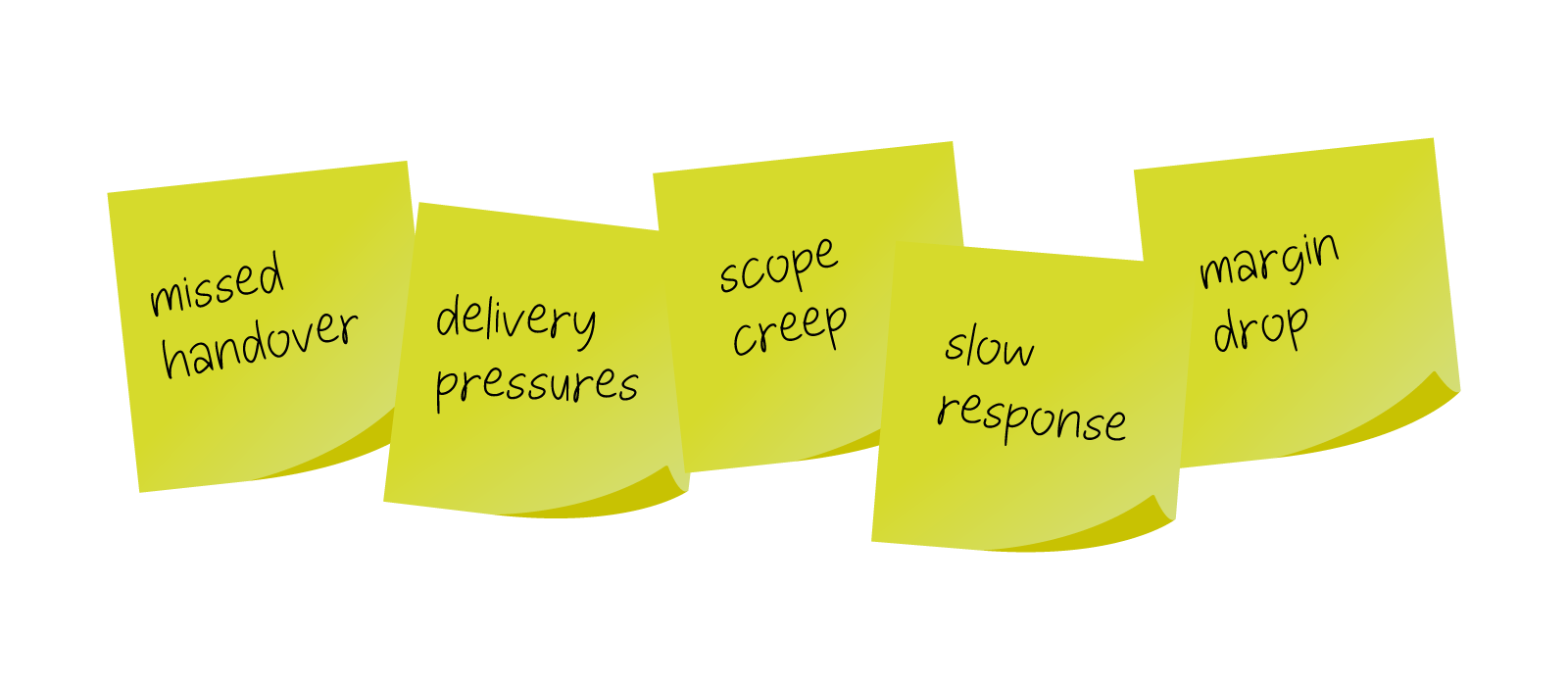
The problem you can see is not always where it begins. The FARiN Review examines what is happening across the business, identifies the causes and conditions behind it, and turns the findings into clear priorities and practical next steps.
post it note farin

What the Review includes

Every FARiN Review includes a written diagnostic report and a findings call. The report explains the problem being examined, the evidence gathered, the causes and contributing factors identified, and the practical priorities that follow.

The supporting analysis is selected around the situation. It may include market intelligence, buyer insights, competitor analysis, digital presence, commercial assets, processes, systems, or how information, responsibility and decisions move through the business.

You receive the evidence needed to understand the problem, not a fixed bundle of reports that may have little bearing on it.
Price: £995

When a Review makes sense

A FARiN Review makes sense when the problem is visible but the cause is unclear, several explanations are competing, or the issue affects more than one part of the business. In those situations, an initial conversation may not provide enough evidence to decide what should change.

Several explanations are competing

Different people, teams or advisers have different views of what is causing the problem, with no clear basis for choosing between them.

Previous changes have not worked

Time or money has already been spent on new tools, processes, people or activity, but the problem remains unresolved.

Problem appears in several places

The effects can be seen across sales, handover, delivery, margin, capacity or client experience, but the causes are still unknown.

Proposed fix is expensive if wrong

A hire, system, supplier or major process change is being considered, but there is not enough evidence that it addresses what is actually causing the problem.

Unclear what to tackle first

Several issues may be connected, and the business needs a clearer view of which one is driving the others and where action will have the greatest effect.
A FARiN Review is not needed when the problem and the right response are already clear.

Find the cause, not just the symptom

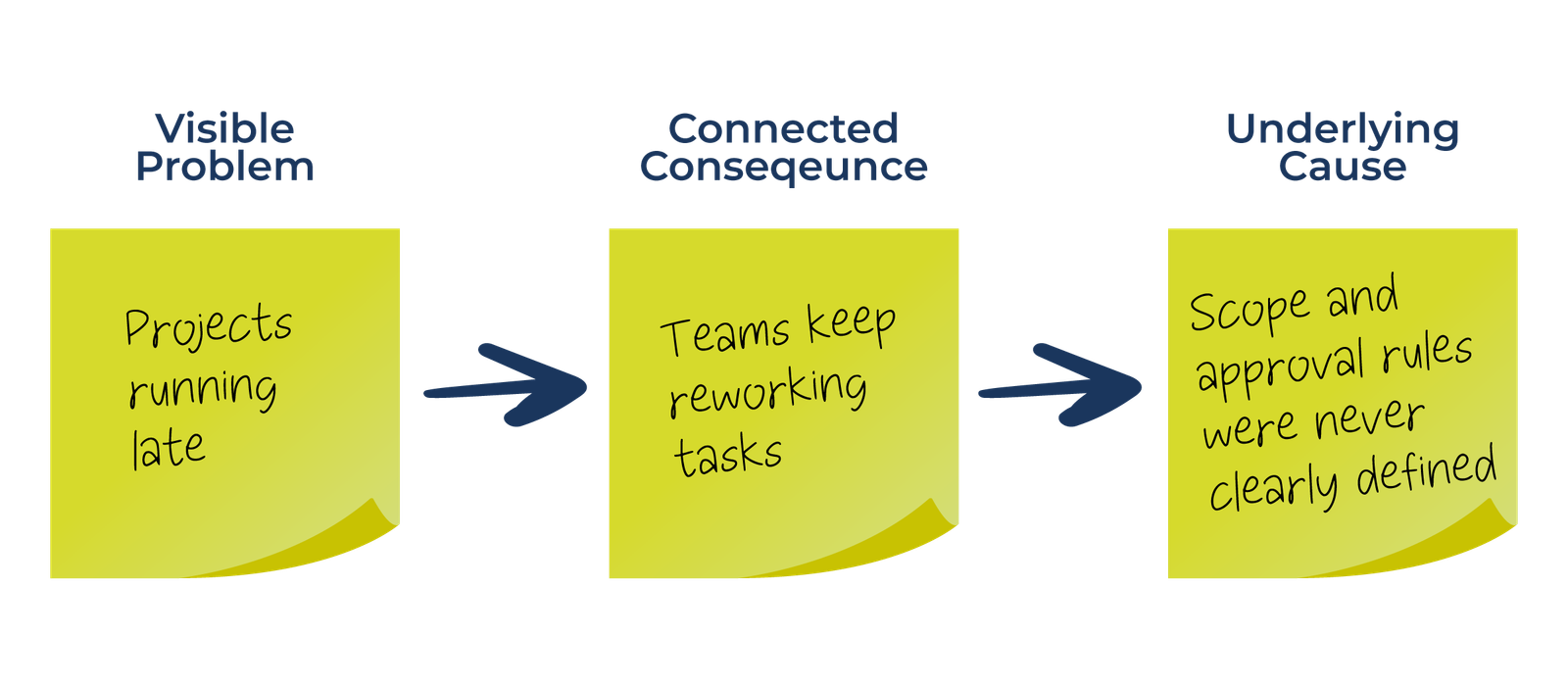
A problem often becomes visible in one part of the business even though it begins somewhere else. Delivery delays may start with unclear scope. Margin may be lost through pricing, promises or handover. Weak sales results may be connected to positioning, capacity or the client experience.

The FARiN Review separates the problem you can see from the consequences it creates and the causes behind it. This helps identify where action should begin, rather than spending time and money fixing the symptom alone.
connected causes post it note

What the Review examines

The FARiN Review does not examine every part of the business by default. The evidence gathered follows the problem and may involve one area, several connected areas or the movement between them. Five connected lenses are used to organise the examination and understand how the issues may connect.

What it examines

Whether the work has a clear, documented base, including its purpose, standards, responsibilities, agreed processes and what it is expected to produce.

What it can reveal

Missing standards, unclear responsibilities, undocumented ways of working, or work that depends too heavily on memory, habit or individual interpretation.

What good looks like

People can understand what is expected, how the work should operate and who is responsible without relying on one person to explain it.

What it examines

Whether the systems, processes, tools and working structures needed to support the work have been deliberately designed for their actual purpose.

What it can reveal

Tools adopted for convenience, processes built around old circumstances, duplicated effort, structural gaps or ways of working that become fragile when demand or conditions change.

What good looks like

The structures supporting the work fit what the business needs them to do and make consistent delivery easier rather than creating extra work or dependency.

What it examines

Whether information, decisions, responsibility and work move clearly between the people, systems and stages that depend on them.

What it can reveal

Broken handovers, delayed approvals, lost context, unclear ownership, bottlenecks or important information failing to reach the right place.

What good looks like

The right information, decisions and responsibilities reach the right people at the point they are needed, without repeated chasing or unnecessary interpretation.

What it examines

Whether decisions and ways of working are based on relevant evidence, or on assumptions that have not been tested or updated.

What it can reveal

Incomplete or unreliable information, unsupported beliefs, decisions made from outdated evidence, or useful learning that exists but is not being used.

What good looks like

The business can explain why it is making a decision, what evidence supports it and what would cause that view to change.

What it examines

Whether the work, systems and processes in place are being reviewed, maintained and improved as the business learns and conditions change.

What it can reveal

Ways of working left to drift, outdated documents or systems, recurring problems that are never examined, or improvements that depend on someone noticing them informally.

What good looks like

The business reviews how the work is operating, carries learning forward and keeps what it has built useful as circumstances change.

The lenses organise the examination, but the findings are written in the language of your business, not as abstract framework labels.

How the Review works

The FARiN Review follows five stages, from the initial conversation and agreed scope through to the written findings and discussion of what comes next. The exact evidence gathered depends on the problem and what is needed to understand it properly.

Discuss the Problem

The process begins with a free advisory call to discuss the problem, what is already known and what has been tried. If the cause and the right response are already clear, a FARiN Review may not be needed.

Agree the Scope

If a Review is warranted, the problem being examined, the boundaries of the work, the evidence required and any exclusions are agreed before the Review begins.

Examine the Evidence

An in-depth diagnostic call is supported by the relevant documents, records, data, systems or other materials needed to build the picture. The evidence is then examined through the five FARiN lenses to identify what is working, what is absent or misaligned, and where the causes and consequences may sit.

Interpret the Findings

The findings are connected and tested against the available evidence. This establishes the best-supported explanation of the problem, what deserves attention first and what should remain unchanged.

Receive the Review

The written report is normally sent within 7–10 working days of the diagnostic call and receipt of all agreed materials, whichever is later. It is sent before a 60–90 minute findings call, giving you time to read and consider it before discussing the conclusions, priorities and possible next steps.

What the Review does not include

The FARiN Review identifies the causes and contributing factors behind the problem, what deserves attention and the direction any response should take. It does not include the detailed strategy, implementation or ongoing support needed to put that response in place.

Not a performance scorecard

The Review does not measure the business against generic benchmarks or reduce a connected problem to a single score. It examines the specific conditions and evidence relevant to the problem being reviewed.

Not a fixed strategy

The Review identifies the causes, consequences and priorities involved, and explains the direction any response should take. A detailed strategy, action plan or implementation specification is separate work.

Not a standard audit

The scope follows the problem. The Review examines the areas, connections and evidence needed to understand it, rather than inspecting every function, tool or process in the business.

Not a manufactured problem list

The Review confirms what is working as well as what is absent, unclear or contributing to the problem. It does not invent weaknesses to make the findings appear more substantial or create unnecessary follow-on work.

Not a compulsory first step

A FARiN Review is only recommended where deeper examination is needed. If the problem and the right response are already clear from the initial conversation, another form of support may be more appropriate.
The value of the Review is the clarity it creates, not the amount of additional work it generates.

The FARiN Review

A standalone, evidence-led review designed to identify what is causing the problem, how the issues connect and what deserves attention first.
What's included
  • Agreed Review scope
  • In-depth diagnostic call
  • Relevant evidence gathering
  • FARiN examination and analysis
  • External analysis where relevant
  • Written diagnostic report
  • Directional recommendations
  • 60–90 minute findings call
Fixed fee

£995

No compulsory follow-on work
£995 credited in full against qualifying follow-on work commissioned within three months*
*Applies to agreed implementation or hands-on support above the minimum engagement value. Full terms are confirmed before the Review begins.

See what the Review can reveal

Every FARiN Review is shaped around the situation being examined. These examples show how different evidence sources were brought together to clarify what was working, what was getting in the way and where attention was most valuable.

Where interest does not become commitment

A sustainable packaging business selling to brands, manufacturers and packaging partners.

The Visible Problem

The business had strong market visibility, credible proof and regular signs of interest, but too little of that interest was progressing into firm commercial commitment.

What Seemed to Explain It

The problem could easily have been attributed to buyer caution, slow market adoption or the need for more sales activity.

What the Review Examined

The Review brought together the business’s sales assets, digital presence, commercial conversations, buyer groups and wider market evidence to understand where momentum was being lost.

What the Evidence Revealed

Three different buyer groups were being taken through overlapping commercial stories, even though each faced different pressures, risks and decisions. The material was credible, but buyers were being left to work out for themselves what mattered to them and what should happen next

Where Attention Shifted

Attention moved away from generating more general interest and towards separating the buyer journeys, clarifying the conditions that signalled readiness and making each commercial asset support a defined stage of the decision.

Where a successful referral model starts to limit growth

A specialist engineering and project management business with a strong reputation, high repeat work and a referral-led pipeline.

The Visible Problem

The business wanted a more predictable route to growth beyond its existing network without weakening the quality or selectivity of the work it accepted.

What Seemed to Explain It

The obvious answer appeared to be more marketing, a stronger website or a wider programme of new-business activity.

What the Review Examined

The Review examined how work was originating, where trust was concentrated, what prospects could validate before speaking to the business, and how commercial growth connected to leadership capacity and delivery quality.

What the Evidence Revealed

Around 96–97% of work came through repeat business or referral, which created a highly effective but concentrated commercial model. Trust, early conversations and much of the commercial story depended heavily on senior leadership, while the wider team and delivery capability were harder for prospects outside the network to asses

Where Attention Shifted

Attention moved away from generating demand as widely as possible and towards controlled growth: making the wider capability easier to validate, transferring trust beyond one individual and targeting only the work the business could absorb without compromising delivery.

Where engagement does not become conversation

A specialist consultancy selling into long, scrutiny-heavy buying cycles.

The Visible Problem

The business had a large segmented database, regular content, website activity and signs of prospect engagement, but commercial conversations remained inconsistent.

What Seemed to Explain It

The problem could have been blamed on weak content, an unresponsive market or a database that had already been exhausted.

What the Review Examined

The Review looked at how opportunities originated, how engagement was being followed up, how long buyers took to act, what signalled genuine readiness and how relationships were maintained between periods of activity.

What the Evidence Revealed

The business could convert well once it reached a live conversation, but the route into those conversations was inconsistent. Buyers often researched quietly over several months, while follow-up depended too heavily on individual habit and quarterly nurture created too few useful opportunities to re-engage.

Where Attention Shifted

Attention moved away from producing more broadcast activity and towards creating a clearer bridge from interest to conversation through more deliberate follow-up, stronger buying-window signals and useful reasons to re-engage prospects over time.

Discuss your situation

Tell me about the problem you are trying to understand, what is happening now and anything you have already tried. You do not need to know whether the FARiN Review is the right next step. The form gives me enough context to prepare for the conversation and decide whether a Review would be useful.

The advisory call is free, and there is no obligation to commission a Review
Morgan Rocquin is a trading name of Simon Morgan, a sole trader. Business address: 2 Rue de la Petite Côte, Geville, 55200, France

Email: simon@morganrocquin.com